
Design an agent with the AI designer
When no template fits, describe the job and Qoren's AI designer drafts a reusable blueprint with you. Answer its questions, review, save and launch.
On this page
When none of the templates matches the job you have in mind, you can describe it in plain words and let an AI designer write the template for you. The designer asks a few follow-up questions, drafts the whole blueprint (the agent's persona, its instructions and its scheduled jobs), and saves it to your organization's templates, so you can launch this agent and more like it whenever you want.
Open the designer#
- In the sidebar, click New agent.
- On the template gallery, click the first card, Design your own.
The page changes to Design your own blueprint. To go back to the gallery at any point, click ← Back to blueprints. For the full walk through the gallery, see create an agent from a template.
Describe the job#
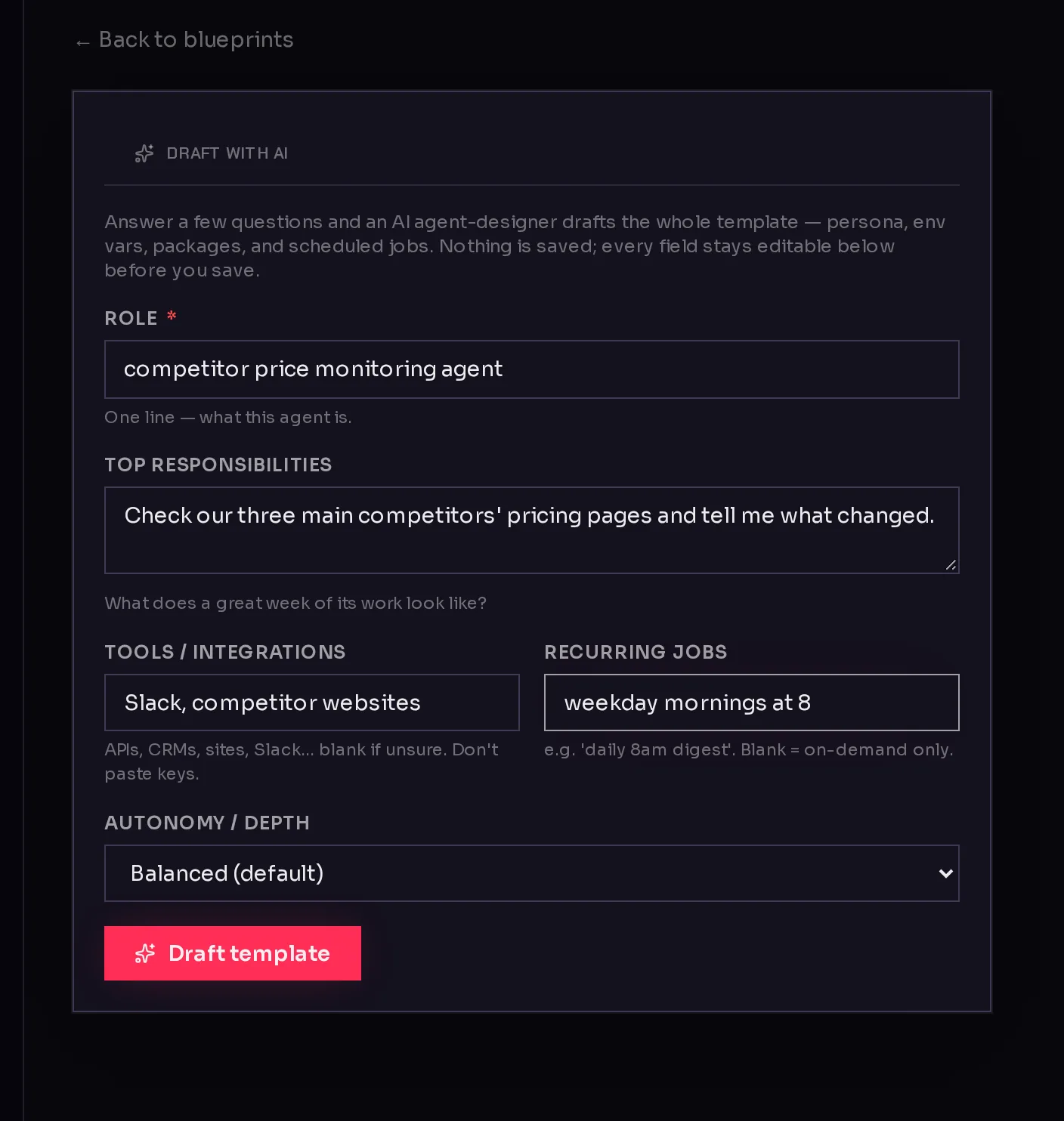
The Draft with AI card asks for a short brief. Only the role is required; the rest helps the designer get it right the first time.
- Role (1): one line saying what the agent is, such as "competitor price monitoring agent".
- Top responsibilities: what a great week of its work looks like.
- Tools / integrations: the services and sites it works with, such as Slack or your CRM. Leave it blank if you are unsure. Do not paste keys here; you add them when you create the agent.
- Recurring jobs: anything it should do on a schedule, such as "daily 8am digest". Leave it blank if it should only work when asked.
- Autonomy / depth (2): how far it goes on its own. Choose Conservative, Balanced (default) or Aggressive.
- Click Draft template (3).
 123
123A short timeline at the top of the card shows the designer's progress while it thinks.
Answer its questions#
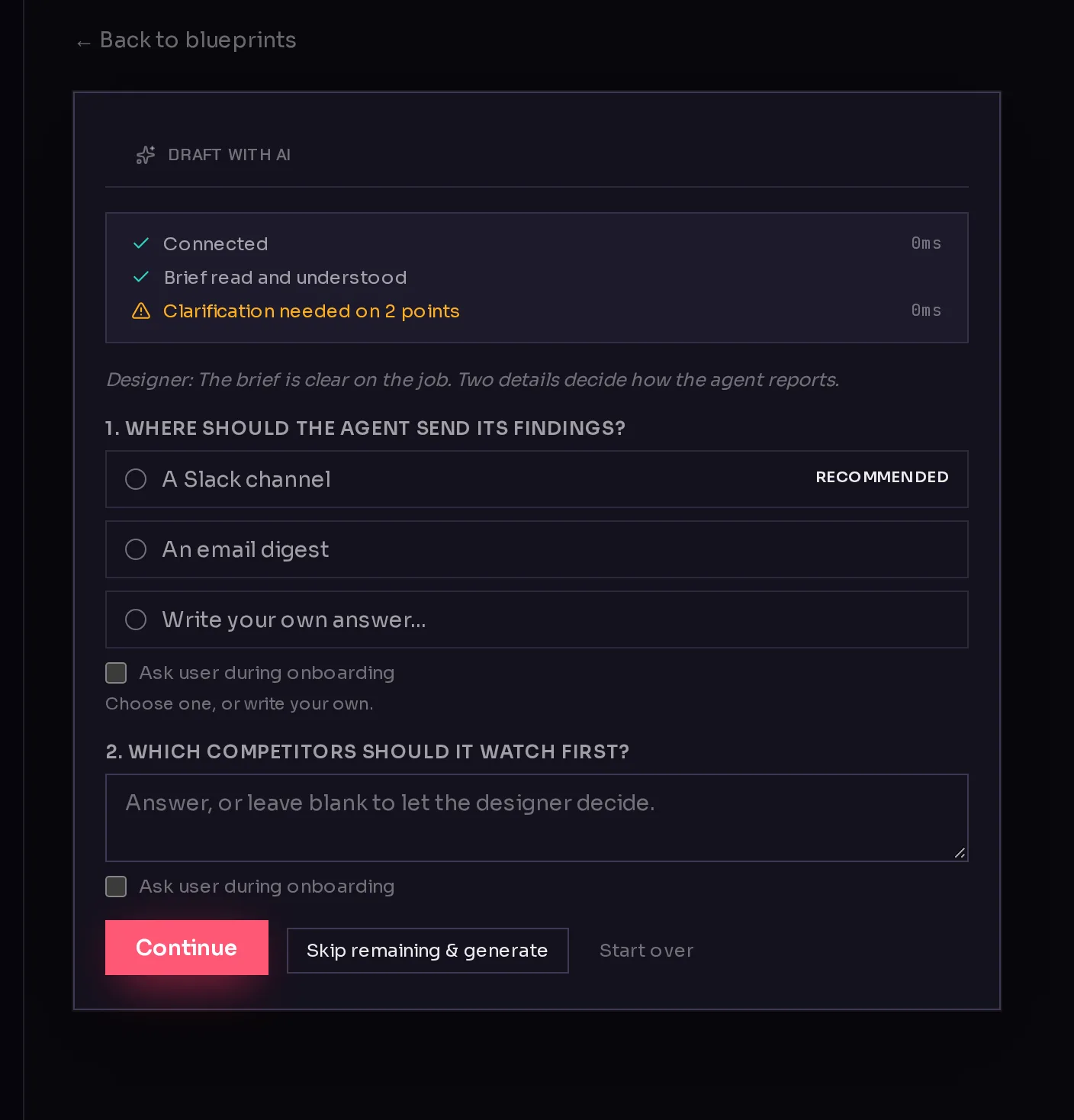
If the brief leaves something open, the designer comes back with a few questions instead of guessing. Its reasoning is shown in a line starting with Designer:.
- For each question, pick one of the suggested answers (1). The one it thinks fits best is marked Recommended. You can also choose Write your own answer… and type one.
- If the answer depends on the person who will use the agent, tick Ask user during onboarding (2). The designer then turns that detail into a setting collected when the agent is set up, instead of fixing it in the template.
- Click Continue (3). The designer may ask another round, or finish the draft.
 1234
1234A question you leave blank lets the designer decide. To stop answering and get a draft now, click Skip remaining & generate (4). Start over clears everything and returns to the brief.
Review and save the blueprint#
When the draft is ready, the designer shows:
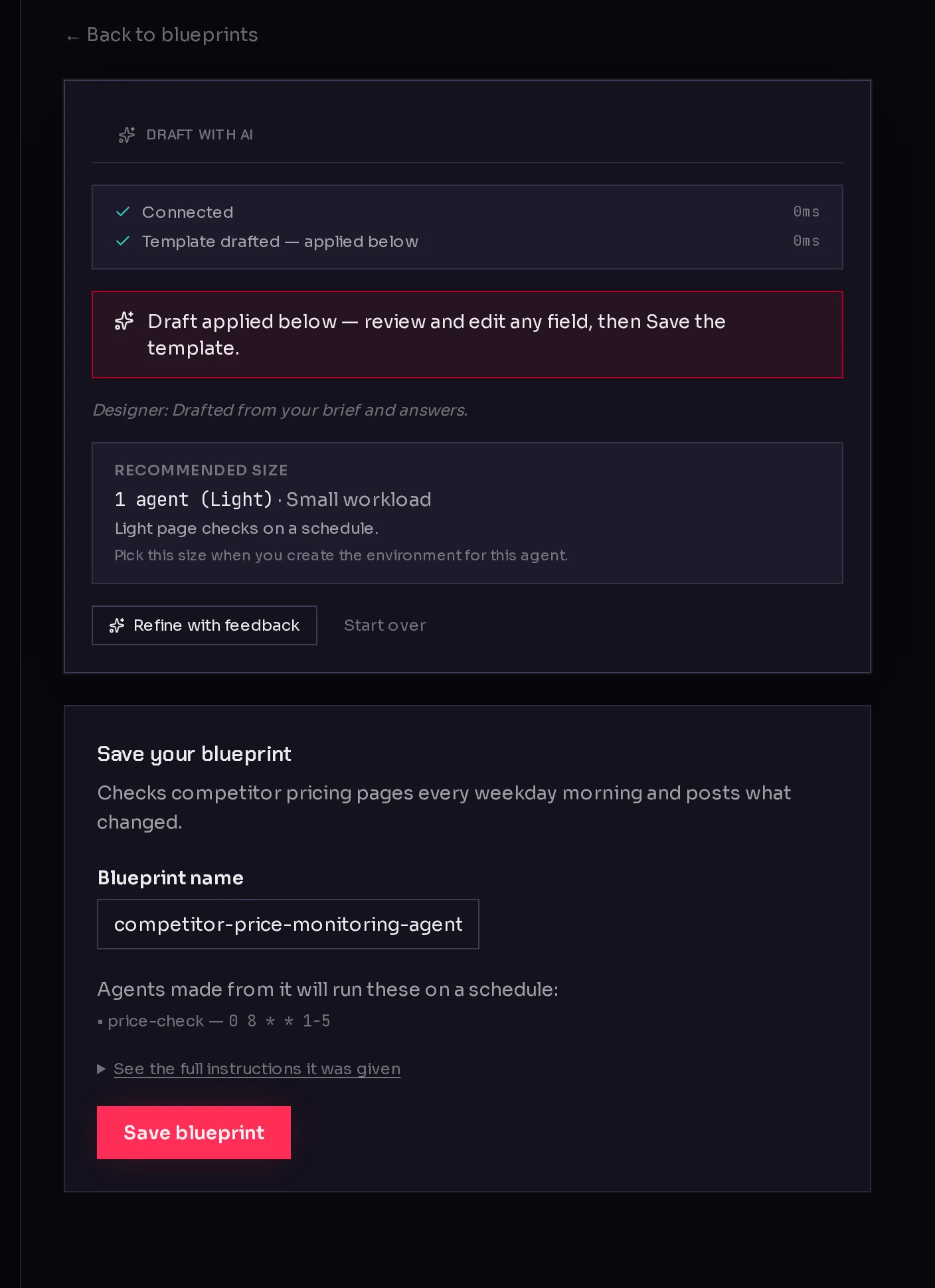
- Recommended size: the environment size it suggests for this agent, with a short reason. Pick this size when you create the environment. It is a recommendation only; the agent still runs on a smaller one. See environment sizes.
- Save your blueprint: a one-line description of what the agent does, and any jobs it will run on a schedule.
- See the full instructions it was given: opens the persona and instructions the designer wrote, so you can read exactly what the agent will be told.
To change something, click Refine with feedback (1), describe the change (for example "make it more conservative and add a weekly summary task"), and click Apply revision. The whole draft is revised.
When you are happy with it:
- Check the Blueprint name (2). It is filled in from the role; change it if you like.
- Click Save blueprint (3). The button reads Checking & saving… while a safety review runs.
 123
123After saving, you go straight to the next step of creating an agent, with your new blueprint already chosen. Name the agent, check the keys and click Create agent, as in create an agent from a template.
If the safety review has notes#
Every blueprint goes through a safety review when it is saved. It checks the draft for things like runaway spending or risky commands.
- This needs fixing before it can be saved: something serious was found and the blueprint was not saved. Each finding comes with a suggested fix. Click Fix with AI to have the designer revise the draft to address them and save again.
- Saved, with notes from the safety review: the blueprint was saved, with smaller points worth a look. Click Fix with AI to address them, or click Keep it as is to use the blueprint unchanged.
Frequently asked questions#
Where does the blueprint go after I save it?
To your organization's templates. It shows in the template gallery when you create an agent, so you can launch more agents from it later. See templates.
Which runtime does a designed blueprint use?
The designer writes blueprints for Hermes, and Hermes is selected when you create the agent. You can pick another runtime on the next step; see runtimes.
Can I edit the blueprint by hand?
Yes, after it is saved. Open it from Templates in the sidebar. Create a template covers editing templates.
Does the designer pick a model for the agent?
No. A designed blueprint leaves the model open, so agents made from it use your organization's default model. You can change an agent's model after it is created.