
Create your own agent template
Build a reusable agent template in Qoren, from scratch, with AI, or from a copy. Set the persona, runtime, size, scheduled tasks, files and tools, then save it.
On this page
A template of your own lets you set up the same kind of agent again and again, for yourself or for each of your clients, without repeating the setup. You can start from nothing, let AI draft it, or copy an existing template and change it.
Start a new template#
- In the sidebar, click Templates.
- Click New template at the top right.
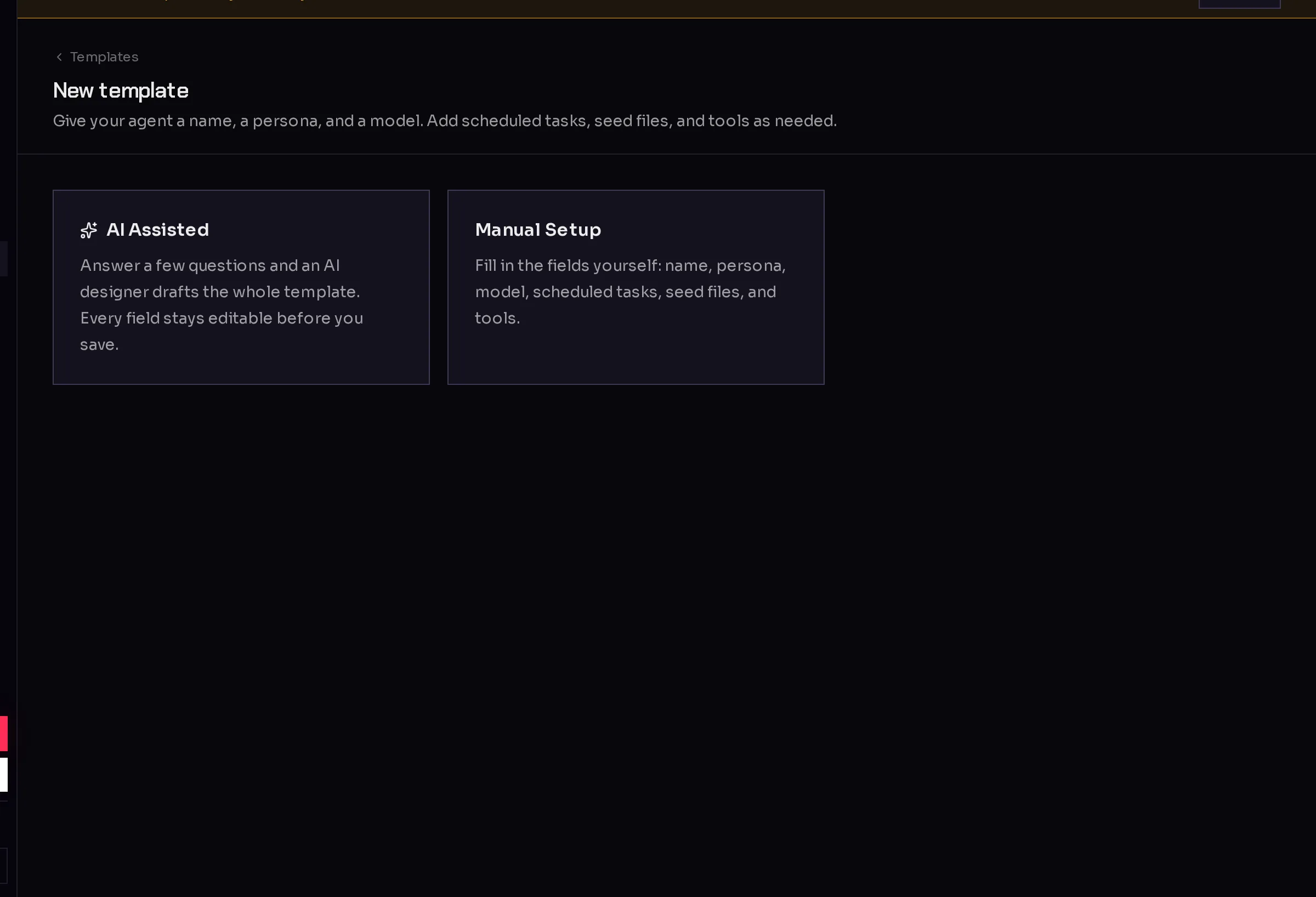
- Choose how to start (1, 2):
- AI Assisted: answer a few questions and an AI designer drafts the whole template. Every field stays editable before you save. The designer's work counts as model usage on your account.
- Manual Setup: fill in the fields yourself.
 12
12Changed your mind? Click <- Choose a different way to start above the form.
To start from an existing template instead, click Customize on its card in the gallery. The editor opens on a copy named after the original with -copy added, and skips this choice. See browse and use templates.
Fill in the editor#
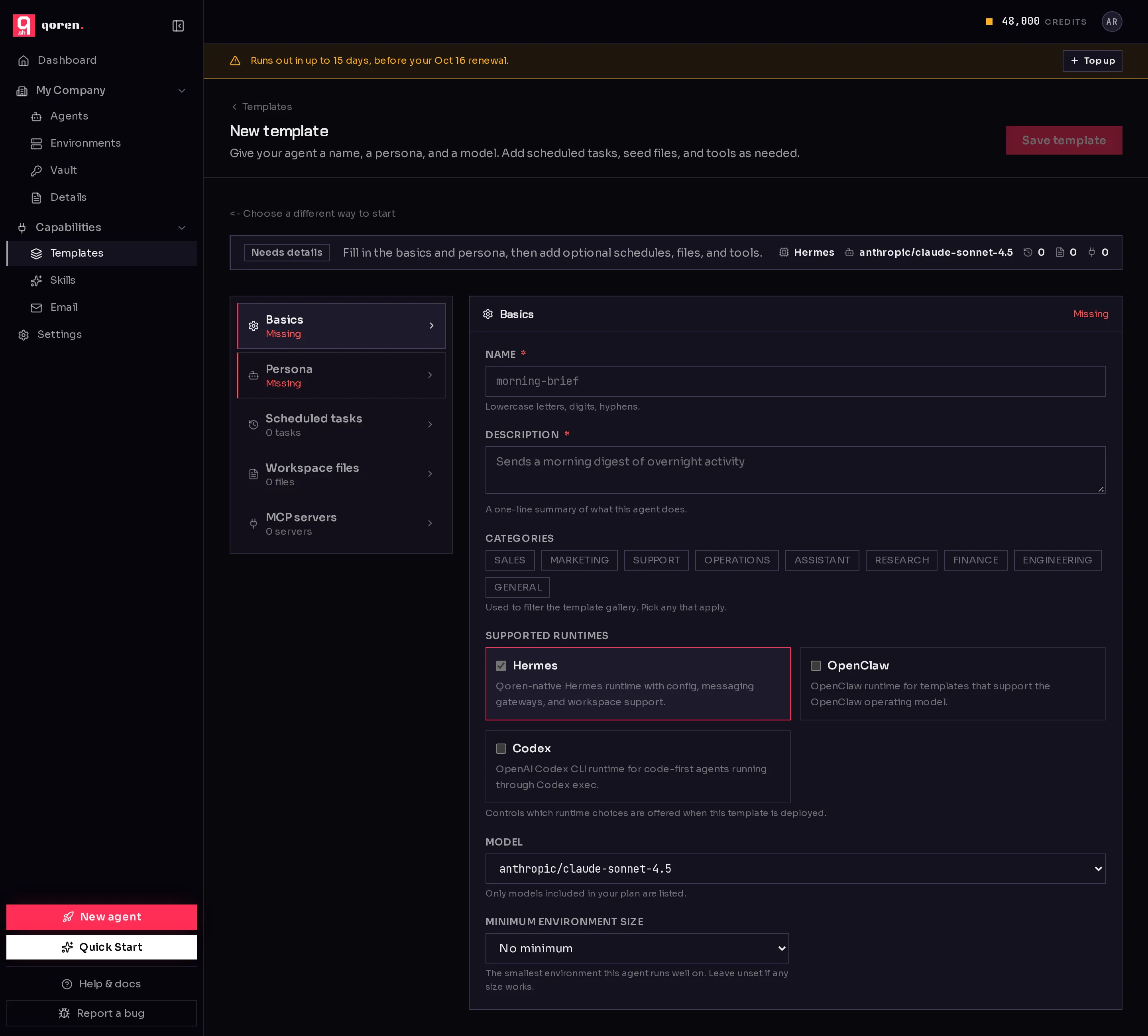
The editor is split into steps, listed on the left (1). Click a step to open it. A step that still needs something shows Missing in red, and the bar across the top says Needs details until everything required is filled in, then Ready to save.
 12345
12345Basics#
- Name (2), required: lowercase letters, digits and hyphens, such as
morning-brief. - Description, required: a one-line summary of what the agent does. It is what people see on the template's card.
- Categories: pick any that apply. They drive the category filters in the gallery.
- Supported runtimes (3): tick Hermes, OpenClaw, Codex or several. This controls which runtimes are offered when someone deploys the template. At least one stays ticked. See runtimes for the differences.
- Model: the AI model agents start with. Only models included in your plan are listed.
- Minimum environment size (4): the smallest environment this agent runs well on, or No minimum. When you pick a size, also set the Requirement level: Recommended only shows a notice when someone deploys onto a smaller environment, while Required refuses the deploy. See environment sizes.
Persona#
Two documents that make up the agent's brain:
- Persona - voice & boundaries (required): who the agent is, its tone and what it must not do. It becomes the agent's
SOUL.md. - Playbook - how it works: its job, how it works and what it delivers. It becomes the agent's
AGENTS.md.
Each box shows a live line count, and suggests a length to aim for while the text is still short. For tips on writing these, see agent identity and instructions.
Scheduled tasks#
Tasks the agent runs on its own, on a schedule. Leave this empty for an agent that only works when asked.
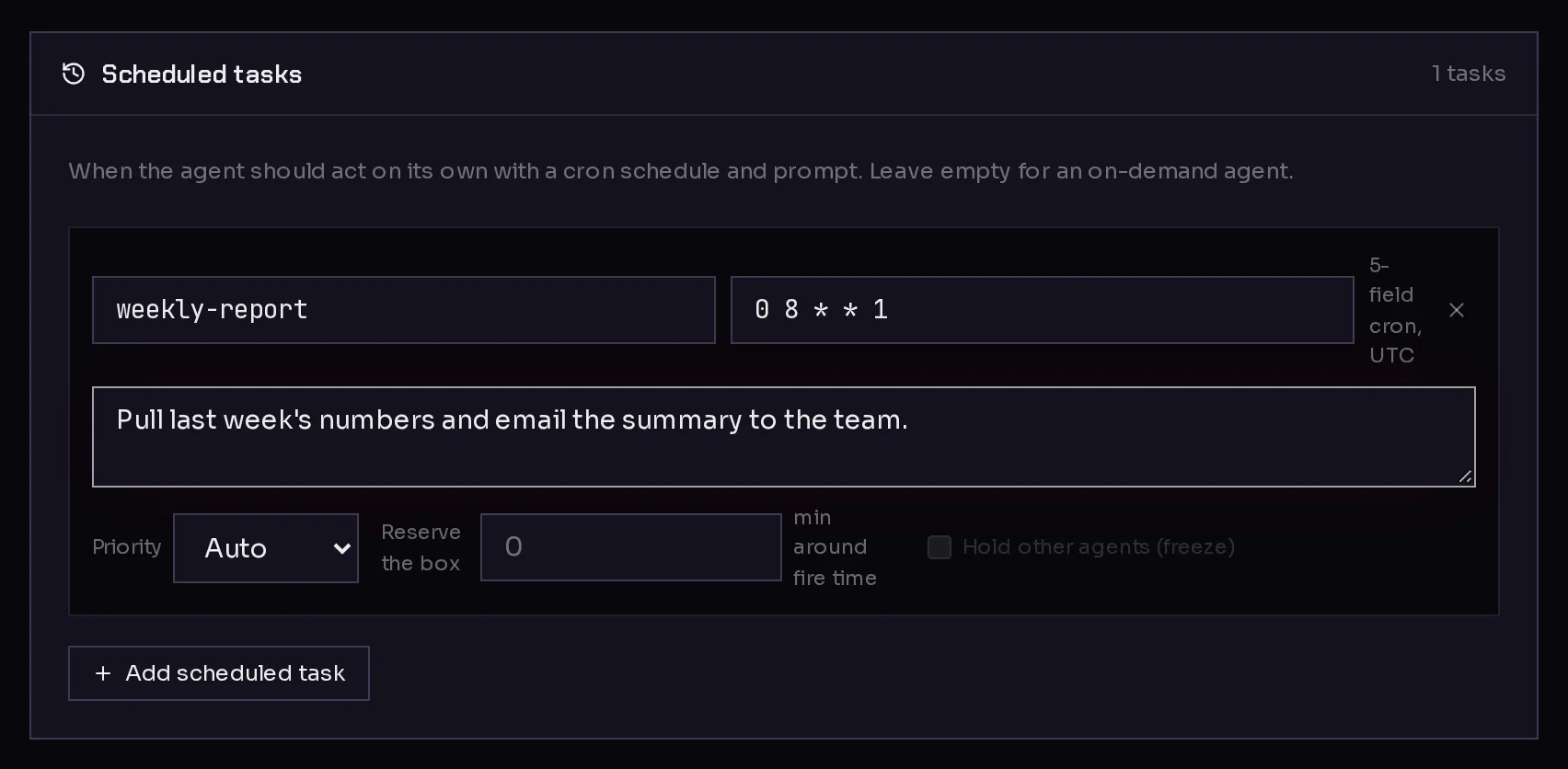
- Click Add scheduled task (3).
- Give the task a short name, such as
weekly-report(lowercase letters, digits and hyphens). - Enter the schedule (1) as a 5-field cron expression in UTC. For example,
0 8 * * 1runs every Monday at 08:00 UTC. - Write the instruction the agent follows each run (2). Make it complete on its own: the agent reads it fresh every time.
- Optionally set a Priority (Auto, Low, Normal, High or Critical), or reserve the environment for a few minutes around the run with Reserve the box, up to 15 minutes. With a reservation set, you can also tick Hold other agents (freeze) to hold back the other agents on that environment during that window.
 123
123More on schedules, including changing them on a running agent, is in schedules.
Workspace files#
Starting knowledge the agent reads from, such as your ideal customer profile or a style guide. Each file has a path (for example workspace/ICP.md), a short note on what it is for, and its contents. The files are written into the agent's workspace when it is created, and the agent refines them as it learns.
Do not put passwords or API keys in workspace files. Keys belong in the vault.
MCP servers and platform access#
MCP servers are the outside tools the agent can call, such as GitHub or a CRM.
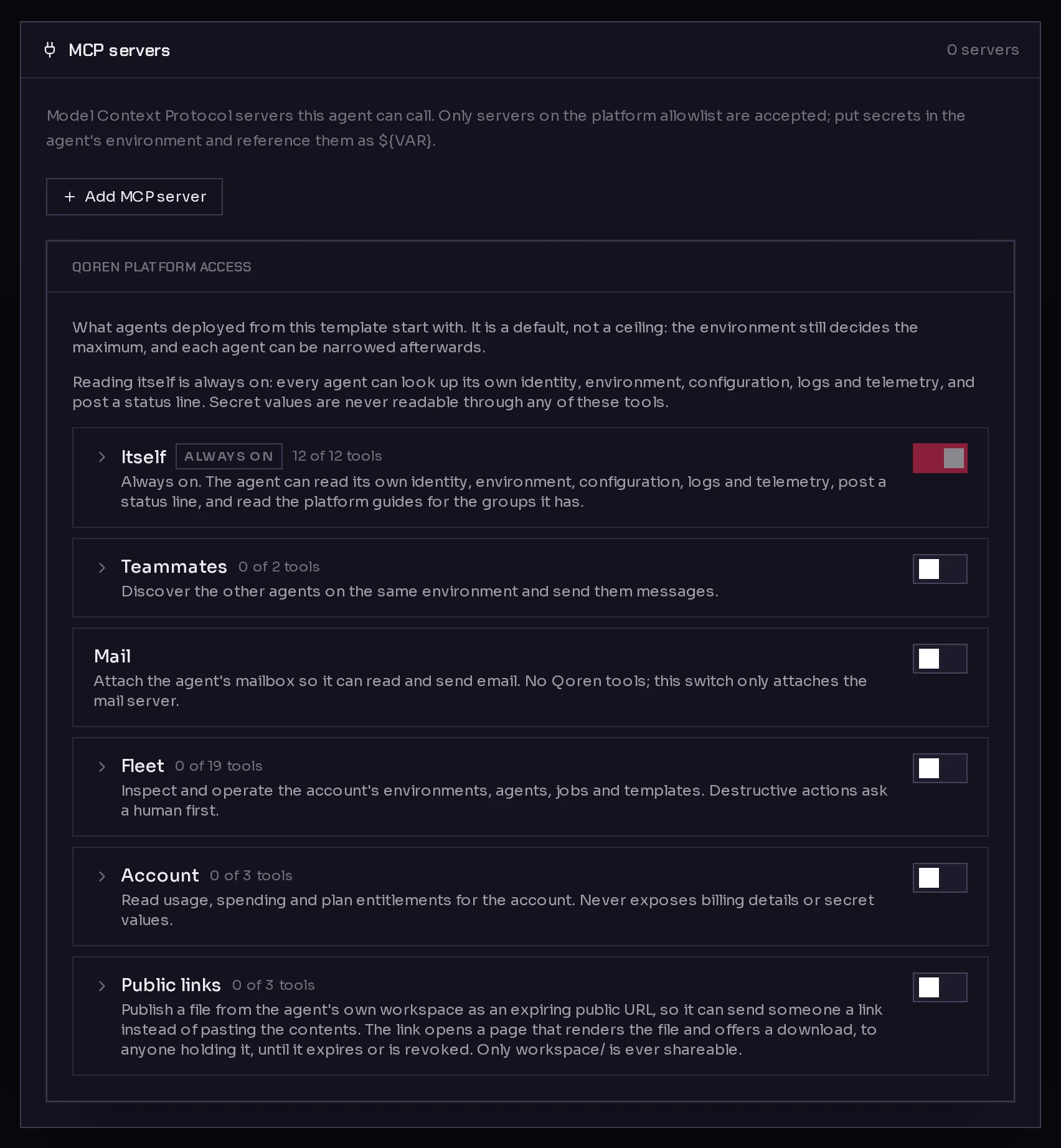
- Click Add MCP server (1).
- Give it a name and choose stdio (local) for a server that runs on the environment, or http (remote) for one reached over the internet. Fill in the command or address.
- Where the server needs a key, do not paste the key here. Put it in the agent's keys and reference it as
${NAME}, for exampleAuthorization=Bearer ${API_KEY}.
Only servers on Qoren's approved list are accepted.
Below the servers, Qoren platform access (2) sets what agents from this template may do through Qoren's own tools: message teammates, use their mailbox, see and manage your environments and agents, read usage, or share files by link. Every agent can always read its own details, and no tool ever reveals a secret value. This is a starting default: the environment still sets the maximum, and you can narrow each agent later. See agent permissions.
 12
12Save the template#
- Click Save template at the top right.
- Qoren runs security checks on the template before saving it. This takes a moment.
What happens next depends on the checks:
- Nothing found: the template is saved and its page opens.
- Serious problems: the template is not saved. The findings are listed, with a Fix with AI button that revises the template to address them and saves it again. You can also fix them by hand and save again.
- Minor warnings: the template is saved, and the bar reads Review warnings. Click Fix with AI to clean them up, or keep the template as it is and open its page.
Your new template now appears in the gallery with the Yours badge.
Edit, copy or delete your template#
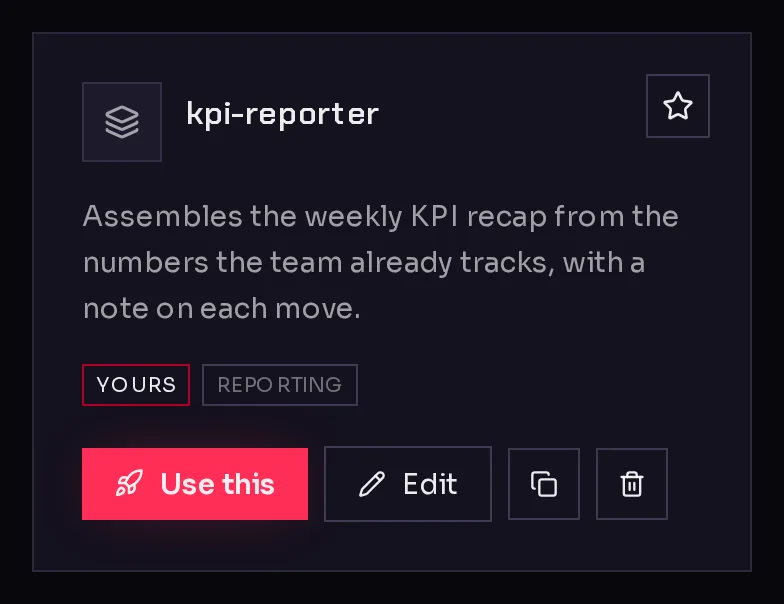
Templates you made have extra buttons, both on their card in the gallery and on their own page.
 123
123On the template's page, the same actions sit next to Deploy, which starts a new agent from it:
 1234
1234- Edit opens the editor on the template itself. Click Save changes when you are done. Renaming the template moves it, and the agents already created from it follow the new name.
- Duplicate (the copy button on the card) opens the editor on a copy, so the original stays as it was.
- Delete asks you to type the template's name to confirm. Deleting cannot be undone. Agents already created from it keep running, but they lose their link to it: if one is later rebuilt, the template's setup steps are skipped.
Frequently asked questions#
Who can see my templates?
Templates you create belong to your organization. They show in your gallery with the Yours badge and are not shared with other Qoren customers.
Can I edit a template that came with Qoren?
No. Click Customize on it to make your own copy, then edit the copy.
Why can't I save my template?
Check the steps marked Missing: a name, a description, at least one runtime and the persona are required, and every scheduled task needs a valid name, a 5-field schedule and an instruction. If the security checks found a serious problem, fix it or use Fix with AI.
Does changing a template update agents I already created?
No. Agents are created from a template once and then have their own settings. Change a running agent in its own Settings.